Thursday, 8 December 2011

Representation in 'This is England' compared to my own media product

I think This Is England is a gritty social realism film, which partially covers racial aspects through their culture. The main themes in the film are racism, violence and the 80’s skinhead society in which they live. These aspects are portrayed through their masculinity stereotype. A character that is strong, racist and violent and follows the masculine stereotypes is Combo. He acts like a father figure towards Shaun, by buying him new clothes and when they get close, Shaun shows his trust in him when they are racist and steal from a man’s shop. The rest of the gang see him as superior (he has been in prison which makes him more menacing). The director Shaun Meadow’s has constructed Propp’s hero and villain theory where each character is shown in a hierarchy status showing the individuals level of masculinity. It is clear that there is no prejudice portrayed through the representation of age as the young boy easily enters their gang and even has an older girlfriend. However, the representation of race is a highly controversial and important content. Although there is a man of different race in the gang, Combo deliberately intimidates ‘Milky’ when talking about England and the economic crisis. Combo is proud of his country and thinks that foreign people are taking white peoples jobs. I think Combo beats up Milky near the end because he is jealous. He realises that Milky has a nice, big family, where as Combo never had this or a dad to look up to. Because of this, he blames Milky’s race and this is the aspect which he takes his anger out on.


Unlike This Is England, my media product will not have any racism in it because my horror genre is all about the future, and I think many things have changed since the 80's. My product focuses more on the genre than its themes. However, similar to This Is England, I will be using violence. The type of violence and how it is used will be different. In This Is England, the violence includes destroying and vandalising houses (even though my character is a teenager he will not be doing this because it is not central to the plot) and fighting eachother, such as when Combo beats up Milky. My trailer will be targeted at niche audiences and therefore apart of arthouse cinema, as is This Is England. One way we can tell this is because there are no (extreme) special effects.


Representations in my media product:
Genre- A horror genre will be conveyed by the build up of tension through the clip. This will be shown by the use of dark lighting, shadows, edgy music, sound effects, vulnerability of the victim and fast cut editing.

Class- The small sized house represents working class. 
Gender- The gender representation is not stereotypical for a horror. By challenging conventions, I will make the male the victim. Also, a male is taking the dog for a walk, not a female which shows how the hierarchy of gender has changed from what it would have been in the 1980's.
Age- The teenager is the one to take the dog for a walk, while typically the mother of the boy tells the boy to be careful (stereotypical caring mother). 
Race- White-British.
Disability- None.

Health & Safety


I have visited http://www.bbc.co.uk/filmnetwork/filmmaking/guide/production/health-and-safety in order for health and safety advice during filming. I have outlined in red the most important advice I need to follow. Because it will be getting dark in the forest, I will be bringing extra lighting equipment such as a torch. It also says at least one member of the crew needs to have an awareness of health and safety issues- ironically, last year I took part health and safety programme/course lasting for about half a day. It poses that horror films and films involving animals are most risky. As I am taking on both these assets, I will discuss with the actors/actresses the dangerous possibilities to be avoided. For example, the dog I will be using needs to be supervised at all times.


Five steps to risk assessment aims to help assess health and safety risks:

  1. Identify the hazards
  2. Decide who might be harmed and how
  3. Evaluate the risks and decide on precaution
  4. Record your findings and implement them
  5. Review your assessment and update if necessary

Camera types and Iconography

Camera work is expressive rather than naturalistic. Using weird angles and canted cameras are common in horror films. They also contain, like most films and trailers, close-ups and point of view shots to express the characters fear/worry and to make the audience involved, intrigued and tensed up. For example, 'The Blair Witch Project' repeats the use of the close-up to examine the horrified expressions, and 'Cloverfield' uses point of view and canted angles to make it seem like the audience is there.
Iconography: Visual aspects can signify and determine the genre. Red and Black colours are used on horror film posters usually, and blue filters are added to fit the genre. Blue filter is a digital colour correction used in the editing process for an outcome of an eerie effect. Film makers used to go through the process of using filters on lights and camera, or get the footage exposed just the right way. It was expensive and difficult so there was a limited amount of people who could use it.

Questionnaire response


As you can see, 56% were females and 44% were male. These responses may be biased as most of my friends are female. It may also be because females are stereotypically more likely to help.
The majority of the people are in the 15-20 age range which means I need to target this age group. My questionnaire was clearly targeted at a small demographic of people, therefore my audience targeted will be a small amount of people (niche audiences).
Most people visit the cinema once a month according to these results. This is what I expected because when people go to the cinema, it is for an occasion or it is just to go with friends for something to do.
I got some detailed responses for number 4. Most of the audience like horror films, with some exceptions.
Overall, to determine a good trailer I need it to be an insighting storyline but not giving too much away, fast paced, intense music that gradually builds up and perhaps a voice-over so that it speaks the audience and involves them more.

Music rights

://www.bbc.co.uk/filmnetwork/filmmaking/guide/before-you-start/music-rights
This website outlines music rights in films, and this has helped me to understand incidental music, who owns the right to the music and legal guides.

diegetic and synchronous sound: speaking, car engine, footsteps, wind, leaves rustling, dog barking, screaming.
non-diegetic and asynchronous sound: voice-over, music, sudden jolts of sound.

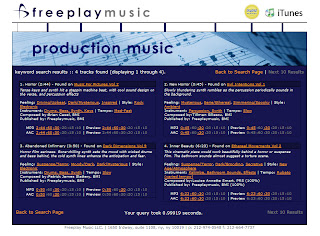
I have considered using http://freeplaymusic.com/ to find and use music for my piece.
By searching in "horror" this is what I have found:


I have recently received an email from Vimeo, and it explains a new feature of theirs; a music store. I have looked on this website and I am considering using this to get my music for my media product.


Sound Effects
 
This is soundsnap.com, it is free to browse and preview all sounds. By looking on here, I have found some good sound effects and sounds I may use.


Exhibition and Distribution

The UK Film Council work to make non-mainstream films more accessible in three ways:
  • Improving access – our Digital Screen Network is made up of 240 digital screens across the UK that now show non-mainstream films regularly.
  • Raising awareness – Our Prints and Advertising Fund provides £2 million every year to help British distributors promote non-mainstream films.
  • Increasing information – our website, http://www.findanyfilm.com/ is one of the UK's leading websites for film fans looking to watch, buy, download or rent great films
Unfortunately, the UK Film Council has been abolished, transferring it's responsibilities to the BFI. "From 1 April 2011, the British Film Institute (BFI) has become the lead body for film in the UK. Most of the UK Film Council's core functions have transferred to the BFI - including the distribution of National Lottery funding for the development and production of new British films, as well as audience development activity through supporting film distribution and exhibition."
This is revelant to my media product because I will have a low-budget, therefore my film will not be as mainstream as other, high-budget films. This is because I will not be able to afford professional editing technology, actors or distribution themes.

Channels for exhibition and distribution:
Broadcasting, cable, satellite, theatrical, non-theatrical, home video, audio, multimedia, corporate and in-house.

Once a film is made, these are some of the people to consider when I sell it to audiences, via cinemas, retailers and rental films across the UK:

McDonald and Rutter
One of the leading practitioners in the specialised world of film PR, it will champion a new feature in all areas of the media in a bid to give it as high a profile as possible to cinemagoers. McDonald and Rutter will also help with a film's UK launch. This means sitting down with the film's UK distributor and talking through the film's appeal and devising a media strategy. Would the film benefit from a lot or a small number of screenings? Once this strategy is in place, the company will then arrange press interviews and photo shoots to boost the film's profile.

Julia Short, Head of Marketing
Julia Short is a partner in Verve Pictures and a film marketing specialist, with credits including 'Silence of the Lambs' and 'Bullet Boy'.

Susan D'Arcy, Unit Publicist
"My remit includes working closely with the stills photographer, captioning all the photographic material. I work with the documentary team making the EPK (Electronic Press Kit) ensuring they get the material they need. I also write all the publicity material for the film. This involves interviewing all the actors and key crew to produce production notes for the press that explain the film and profile the people making it."

Here is a website to help what to do when exhibiting a film and how to, and if your eligible to, require a cinema licence;


Cinema City (Norwich) is an arthouse cinema, showing independent films aimed at a niche market rather than a mass market audience. I have a low budget, which contributes as to why I will be using Cinema City to show my trailer and film.

Wednesday, 7 December 2011

Casting my actor

I have been organising which actors and actresses to use in my trailer. The main character role was the most important, so here's my procedure, expectations and who I have chosen, and why.
I began exploring profiles on Facebook, to see who looked the part. I narrowed it down to a few males and then contacted them in person and asked them if they would be available, and what acting experiences they had. Fortunately, I found Matthew Jones. He seemed intriqued into the film when I explained it to him, and he was available on the dates of the shooting. Although he hasn't had professional/paid acting experience, I can not afford to pay these type of actors anyway. Luckily, he had studied Drama at GCSE and gained a B grade.

Matthew is quite tall, with short brown hair and a medium build. This was perfect as I didn't want anyone who was too skinny because I wanted to challenge conventions; therefore wanted to cast a stereotypical male figure ('manly') so that I could turn conventions on the head and use him as a victim, rather than the villain. The last thing to do was getting him to sign a form, and begin filming.