Showing posts with label Research. Show all posts

Sunday, 12 February 2012

The Three Act Structure

Syd Field, author of Screenplay and The Screen Writer's Workbook, has outlined a paradigm that most screenplays follow. A paradigm is a conceptual scheme. This paradigm is the structure that holds screenplays together. According to Field, screenplays follow a three-act structure, meaning the standard screenplay can be divided into three parts: Setup, Confrontation, and Resolution.
Act I comprises the first quarter of the screenplay. (For a two hour movie, Act I would last approximately 30 minutes.) As mine is a trailer, this is the first 30 seconds.
Act II comprises the next two quarters of the film. (For a two hour movie, Act II would last approximately 60 minutes.) Meaning my trailer it will be between the one minute mark.
Act III comprises the final quarter of the film. (For a two hour movie, Act III would be the final 30 minutes.) The final 30 seconds in relation to my trailer.

The Three-act Paradigm:


Monday, 16 January 2012

Blackouts in trailers

I have noticed that all teaser trailers use some sort of black screen during clips. I googled this and ironically, it came up with the film 'Blackout'. But this trailer also includes the blackouts I'm looking for! For example, there's one at 00:09 and there is a non-diegetic sound that comes with it. This technique is heavily used in my trailer to portray a sense of anxiety.

http://www.traileraddict.com/trailer/the-blackout/trailer

Saturday, 14 January 2012

Taglines/slogans

A tagline is a variant of a branding slogan typically used in marketing materials and advertising. The idea behind the concept is to create a memorable phrase that will sum up the tone and premise of a brand or product (like a film), or to reinforce the audience's memory of a product. Some taglines are successful enough to warrant inclusion in popular culture.
Some examples of memorable film taglines:

  • "In space, no one can hear you scream." – Alien


  • "Just when you thought it was safe to go back in the water..." – Jaws 2


  • "There can be only one" – Highlander


  • "One ring to rule them all." – The Lord of the Rings


  • http://en.wikipedia.org/wiki/Tagline


    Origninally, for my poster design I came up with "There's no place to hide". However, since changing my mind and adding more clips into the trailer, I believe this doesn't necessarily relate to the film as a whole. So, I want a tagline that relates to my title "Son of Perdition" and to the films plot about possession and delusional beliefs. Therefore, I have came up with "dream of death".  It is short, and has the same amount of words as my title. It relates to the fact that after watching this film, you would want to dream of your own death, as the character does. It is like someone saying "You better wish you were dead" (because it is better to have an instant death than to be tortured). Conventionally, taglines give more away and are a sentence. But I have gone against this convention by having another type of "title" for the film. Usually, they act as hints for the film. Like the film 'Scream', their slogan is "Someone has taken their love of scary movies one step too far. Solving this mystery is going to be murder". In my opinion, this is too long for a slogan because I believe a poster should be more visual. You get all the writing on the back of DVD covers, on their website or in film reviews. It would be too much to read, if say, you saw it on the side of a bus that drives past.

    Friday, 9 December 2011

    Typical Convention- Use of the mirror

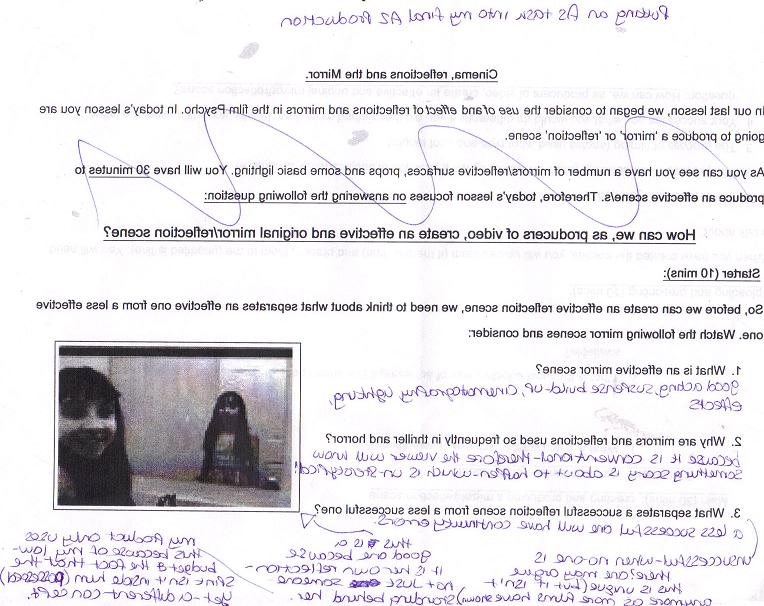
    This is a you-tube clip showing a montage of how many films use the scary, behind-the-mirror technique. It's a convention that is so over-used that films are making parody scenes of it. I am considering using this technique- to follow conventions so that you know something is going to happen, but also to make a twist on the technique.

    
    Why do people enjoy being scared? Joe Bob Briggs, noted "drive in movie" critic, says that "We like to frighten ourselves so that everything else in our lives seems less frightening" Roger Ebert states that good horror movies "can exorcise our demons" ("The Texas Chainsaw Massacre"). Horror movies affect the watcher in tangible physical ways, as well. Fear stimulates the 'fight or flight' response, which kicks off with a rush of endorphins that make the body more alert, tighten the muscles, and slow down nonessential functions like digestion.
    It is possible that the screen acts as a mirror to the audience, who is, after all, deceived as it believes the narrative it sees on the screen to be true when in fact it is merely another well constructed deception. The camera is able to go everywhere, see everything, and ultimately has no limits. The audience's feeling of power is enhanced further by the fact that they are sitting in a darkened, relatively unexposed, 'safe-feeling' auditorium, passively watching the lives of others.
    So, what effect does it have to use mirrors within the film itself? Well, some would argue that through the use of mirror in film, the spectator itself is exposed and thrown into the action, no longer just a passive viewer of the action, but an active part of the action, rudely revealed or harshly thrown into the light and action. The safety and comfort of the auditorium is shattered as they become aware of their own vulnerability. Therefore, the cinematic screen becomes the 'mirror of childhood' described in Lacan's mirror stage. This awareness consequently produces an anxiety in the subject who is unsure whose point of view is being depicted, the on-screen characters or their own. This is made worse as the audience relates this experience to its childhood, where they may well have felt even more exposed and vulnerable. This could be the cause of making mirrors scary in film, and why it has been used so often.

    Scariest film scenes:


    Thursday, 8 December 2011

    Focus Group

    A focus group is a form of qualitative research in which a group of people are asked about their perceptions, opinions, beliefs and attitudes towards a product. My focus group will include roughly 3-4 people, ranging from 18-45, some fitting into my target audience, and one that isn't- to determine their attitudes towards my trailer and whether they would pay to watch it or not. I will be examining their responses and asking them their thoughts about my storyline, techniques used in my trailer, poster and webpage. I have recorded an question and answer session in my focus group, where the focus group will ask me whatever they need/want to know.

    Camera types and Iconography

    Camera work is expressive rather than naturalistic. Using weird angles and canted cameras are common in horror films. They also contain, like most films and trailers, close-ups and point of view shots to express the characters fear/worry and to make the audience involved, intrigued and tensed up. For example, 'The Blair Witch Project' repeats the use of the close-up to examine the horrified expressions, and 'Cloverfield' uses point of view and canted angles to make it seem like the audience is there.
    Iconography: Visual aspects can signify and determine the genre. Red and Black colours are used on horror film posters usually, and blue filters are added to fit the genre. Blue filter is a digital colour correction used in the editing process for an outcome of an eerie effect. Film makers used to go through the process of using filters on lights and camera, or get the footage exposed just the right way. It was expensive and difficult so there was a limited amount of people who could use it.

    Music rights

    ://www.bbc.co.uk/filmnetwork/filmmaking/guide/before-you-start/music-rights
    This website outlines music rights in films, and this has helped me to understand incidental music, who owns the right to the music and legal guides.

    diegetic and synchronous sound: speaking, car engine, footsteps, wind, leaves rustling, dog barking, screaming.
    non-diegetic and asynchronous sound: voice-over, music, sudden jolts of sound.

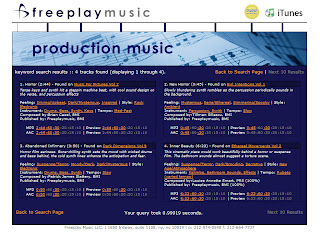
    I have considered using http://freeplaymusic.com/ to find and use music for my piece.
    By searching in "horror" this is what I have found:


    I have recently received an email from Vimeo, and it explains a new feature of theirs; a music store. I have looked on this website and I am considering using this to get my music for my media product.


    Sound Effects
     
    This is soundsnap.com, it is free to browse and preview all sounds. By looking on here, I have found some good sound effects and sounds I may use.
    

    Exhibition and Distribution

    The UK Film Council work to make non-mainstream films more accessible in three ways:
    • Improving access – our Digital Screen Network is made up of 240 digital screens across the UK that now show non-mainstream films regularly.
    • Raising awareness – Our Prints and Advertising Fund provides £2 million every year to help British distributors promote non-mainstream films.
    • Increasing information – our website, http://www.findanyfilm.com/ is one of the UK's leading websites for film fans looking to watch, buy, download or rent great films
    Unfortunately, the UK Film Council has been abolished, transferring it's responsibilities to the BFI. "From 1 April 2011, the British Film Institute (BFI) has become the lead body for film in the UK. Most of the UK Film Council's core functions have transferred to the BFI - including the distribution of National Lottery funding for the development and production of new British films, as well as audience development activity through supporting film distribution and exhibition."
    This is revelant to my media product because I will have a low-budget, therefore my film will not be as mainstream as other, high-budget films. This is because I will not be able to afford professional editing technology, actors or distribution themes.

    Channels for exhibition and distribution:
    Broadcasting, cable, satellite, theatrical, non-theatrical, home video, audio, multimedia, corporate and in-house.

    Once a film is made, these are some of the people to consider when I sell it to audiences, via cinemas, retailers and rental films across the UK:

    McDonald and Rutter
    One of the leading practitioners in the specialised world of film PR, it will champion a new feature in all areas of the media in a bid to give it as high a profile as possible to cinemagoers. McDonald and Rutter will also help with a film's UK launch. This means sitting down with the film's UK distributor and talking through the film's appeal and devising a media strategy. Would the film benefit from a lot or a small number of screenings? Once this strategy is in place, the company will then arrange press interviews and photo shoots to boost the film's profile.

    Julia Short, Head of Marketing
    Julia Short is a partner in Verve Pictures and a film marketing specialist, with credits including 'Silence of the Lambs' and 'Bullet Boy'.

    Susan D'Arcy, Unit Publicist
    "My remit includes working closely with the stills photographer, captioning all the photographic material. I work with the documentary team making the EPK (Electronic Press Kit) ensuring they get the material they need. I also write all the publicity material for the film. This involves interviewing all the actors and key crew to produce production notes for the press that explain the film and profile the people making it."

    Here is a website to help what to do when exhibiting a film and how to, and if your eligible to, require a cinema licence;


    Cinema City (Norwich) is an arthouse cinema, showing independent films aimed at a niche market rather than a mass market audience. I have a low budget, which contributes as to why I will be using Cinema City to show my trailer and film.

    Thursday, 3 November 2011

    Certifications (bbfc.co.uk)


    Certification is the act of certifying or bestowing a franchise on. From looking at the certification rages, and previous exploration of other horror film certifications, I have decided in rating the horror film a 15, but of course I am only making a trailer. Less exposure is presented in a trailer, so I will have different classification (12A) for this. To back-up this idea, here are the various classifications for a film that contains strong bloody violence, named 'Immortals'.


    It is impossible to predict what might upset any particular child. But a ‘U’ film should be suitable for audiences aged four years and over. ‘U’ films should be set within a positive moral framework and should offer reassuring counterbalances to any violence, threat or horror.
    If a work is particularly suitable for a pre-school child to view alone, this will be indicated in the Consumer Advice.
    The ‘R18’ category is a special and legally restricted classification primarily for explicit works of consenting sex or strong fetish material involving adults. Films may only be shown to adults in specially licensed cinemas, and video works may be supplied to adults only in licensed sex shops. ‘R18’ videos may not be supplied by mail order

    General viewing, but some scenes may be unsuitable for young children.
    Unaccompanied children of any age may watch. A ‘PG’ film should not disturb a child aged around eight or older. However, parents are advised to consider whether the content may upset younger or more sensitive children.

    Exactly the same criteria are used to classify works at ‘12A’ and ‘12’. These categories are awarded where the material is suitable, in general, only for those aged 12 and over. Works classified at these categories may upset children under 12 or contain material which many parents will find unsuitable for them.
    The ‘12A’ category exists only for cinema films. No one younger than 12 may see a ‘12A’ film in a cinema unless accompanied by an adult, and films classified ‘12A’ are not recommended for a child below 12. An adult may take a younger child if, in their judgement, the film is suitable for that particular child. In such circumstances, responsibility for allowing a child under 12 to view lies with the accompanying adult.
    The ‘12’ category exists only for video works. No one younger than 12 may rent or buy a ‘12’ rated video work.

    No-one younger than 15 may see a ‘15’ film in a cinema. No-one younger than 15 may rent or buy a ‘15’ rated video work.

    No-one younger than 18 may see an ‘18’ film in a cinema. No-one younger than 18 may rent or buy an ‘18’ rated video work.


    Andrew Pulver- To cut or not to cut: a century of film censorship
    "Cooke says rows over films such as Human Centipede 2 may be entertaining and headline grabbing, but the agency's real work of classification - dealing with about 650 feature films and more than 9,000 DVDs this year - is connected to modifying the age range of people allowed into blockbusters.
    One recent example that Cooke cites is the negotiations over the James Bond film Casino Royale. "It was one of those typical blockbusters that come in on the 12A/15 border. We intervened in a scene when Bond gets whipped on a seat from below. We insisted on a reduction of that."
    There were concerns, too, over the film's violent opening scene, when Bond smashes a man's head into the sink. "It's strong stuff for a 12A," he says. "But we felt the context was quickly established - that this was a Bond film and all that goes with it. In a different context, it might not have been possible to allow it."
    Just as tricky are accusations of preferential treatment. A recent incarnation was the dispute over the treatment of the 17 uses of "fuck" in The King's Speech and Made in Dagenham; the former received a 12A (after initially being classified a 15), while the latter a 15, despite producer Stephen Woolley's outraged protests. Cooke says: "The distinction we drew was that The King's Speech had them all stuttered out in two bursts and was in the speech therapy context - we felt it was a wholly exceptional context which there was no equivalent in Made in Dagenham."

    Thursday, 13 October 2011

    How much do audiences remember of adverts?

    How much do audiences remember if adverts?

    Chigra1
    This is a study taken out in 1989, to see how students study and use examples in learning to solve problems. As you can see, more students take in more information when doing, collaborating and seeing&hearing than just reading, seeing or hearing. I have taken this into account because 'students' are in my target audience age range (teenagers). Therefore, I will not be putting much texts in my trailer so the audience don't have to read a lot, and I will obviously combine visual images with audio.

    Comparingly, Dale's Cone of experience doesn't use quantitive data. Somewhere along the way, someone unnaturally fused Dale's Cone and Treichler's dubious percentages.
    Chigra2

    Attitudes towards violence on TV
    On British television, an estimated average of one violent scene occurs every 16 minutes. At schools, many educators have reported a marked increase in children's aggression both on the playground and in the classroom during the past decade (Barlow & Hill, 1985). This is why my target audience begins at age 15. Many critics believe violence on television can influence teenage behaviour.


  • Is emotional violence just as bad as physical violence?

  • Anyone can be hurt both physically and mentally. Yelling, name-calling and threats are what kids are most likely to experience in the school. Emotionally, violent acts can begin a cycle that leads to physical violence. For example, pushing or shoving, hitting or punching.


  • How do you think TV violence affects children?


  • In some cases, violence presented to children on television may cause children to see the world as a scary and dangerous place; that violence is a normal part of life; that violence is a good solution to many kinds of problems; makes kids less sympathetic to victims of violence; makes kids more interested in violence, both as a form of entertainment and in their real lives; and encourages them to copy the acts that they see on TV. Another area of concern is the addiction factor - the more violent action kids consume, the more they need that level of action and excitement in their entertainment.

    How important are film posters in determining what people go to see?
    An example of how different types of film (e.g. horror) poster use these forms and conventions to attract a certain type of person (e.g. teenagers, horror fans) would be a really scary horror film, which will use eerie images in order to appeal to horror fans. A successful film poster will accomplish attracting the target audience and persuade them to come and watch the film. What attracts audiences- the language used, denotations and connotations, colours/semiotics that stand out and institutions and creators.

    What do audiences do while adverts are on TV?
    In my opinion, if you are watching a film or television programme, people either don't take notice or they flick over or leave the room. There are differences between the typical home environment and cinema. Homes are places full of distractions, and in a cinema you are less likely to leave when the adverts are on. Cinemas also have large film screens which are more dominant than a TV at home. Much research has suggested that while the television is on for large amounts of time in the average household, attention is very rarely truly focused on it. Some people see adverts as 'wallpaper TV'.

    Monday, 10 October 2011

    Comparative research: Shrooms

    'Shrooms' is a 2007 horror film rated 18, directed by Paddy Breathnach.
    Shrooms Poster
    Three couples go to Ireland woods to collect magic mushrooms and trip out. On their way they meet some strange inhabitants of the woods and it doesn't take long until a creepy story is being told at the campfire which might be more than just a story. So strange things happen, people start disappearing, silhouettes move through the woods and the creepy story starts to melt into reality. The horror kicks in along with the effect of the mushrooms.
    Opening Weekend: £313,758 (UK) (25 November 2007) (199 Screens).


    http://www.rottentomatoes.com/m/shrooms/ This website gives an insight on how the film was reviewed. Unfortunately, the percentages for audience rating is quite low. On average, out of 15,653 people, Shrooms got a rating of 2.6 out of 5.


    On IMDB, 6,677 IMDb users have given a weighted average vote of 4.7 / 10. Here, I can also work out their target audience as it shows what gender and ages are more likely to watch the film and if they liked it or not. Although females have rated the film higher than males by 0.3, there were only 909 who have voted. Whereas 5,048 males have voted. So this information may be flawed and does not contain accurate data. However, we can analyse that more males have perhaps watched the film, and have visited the website and offered to vote.


    Trailer:

    Thursday, 6 October 2011

    Comparative research and textual analysis: Insidious

    Insidious is a 2011 American independent supernatural horror film written by Leigh Whannell and directed by James Wan. The storyline: A family looks to prevent evil spirits from trapping their comatose child in a realm called The Furthur. At the end of the film, the evil spirits eventually make it into the real world and to cause pain to others. Like my media product, their is an evil spirit lurking after victims in our world.

    Here is the trailer for Insidious:


    This film, in my opinion, has great cinematography. Even from the opening credits, the makers create an intense, haunting tension by editing the lighting to make it darker and more creepy, and zooming in slowly makes the audience anxious. It does not rely on blood and gore to scare the audience. The tension is much deeper, and heavily relies on sound. It uses quiet, sneaky sounds to bring you in, and makes you jump when non-diegetic loud music is played, and this is when you know something will happen. It intensifies every situation and is what separates its self from other realistic horror movies like Paranormal Activity.

    The mise-en-scene is typical for a horror film. The regular family live in a nice middle-class house in a quiet neighbourhood. The hospital equipment in the boy's room gives the feeling of something dangerous and unstable. It also may indicate pain and death. Beds usually symbolise resting and comfort but it is uncomfortable knowing that a possessed boy is always in this bed.

    There is an eye-line medium close-up of the father which is a very powerful shot as it shows the his distressed facial expression. This is quite unconventional because men are usually seen as strong.

    There is a montage of shots when the child is in hospital. It begins with a close up of the distressed couple and then changes to an over-the-shoulder long shot of the child in the hospital bed. A hospital has connotations of death, pain and illness so seeing the couples gaze at their injured child can actually cause other people to emphasise with them as a parental instinct. There is an eye-line pan when the mother is investigating the rooms as she senses a presence, the camera angle is from her perspective and the pan represents her head movement as she gazes at one room and then to another. This creates suspense as the audience can only see what the character is seeing so it puts you in her perspective that creates a creepy tension.


    There are many fast cuts (editing) later on in the trailer for suspense. There is a quick close-up of a demon which makes the audience jump, especially because the red of the demon's face stands out. It leaves the viewer with a mental image of the demon actually looks like and this can vary on each viewers perception which then influences social interaction.

    In terms of 'Maslows Hierarchy of Needs', this film trailer includes few of the key themes promoted by the theory. The theme of safety isn't offered, but slightly juxtaposed, it may be taken away by the intelligent storyline of which provokes the emotion of fear and adrenaline with the twisted plot. The theme of affiliation is offered as the viewer feels like they aren't the only individual that is feeling this emotion, its reassuring to know that everyone is witnessing the same thing. Lastly the sense of esteem, this may just be from the feeling of knowing "its just a film" and that you can return to safety and reality after.

    The words "Insidious is" cross fades and changes place for example, "Insidious is...Is Insidious". This is a powerful technique as not only is the film title ambiguous they have adapted the definition of Insidious to link to the definition of the film. Insidious means something that proceeds in a gradual, subtle way, causing harmful affects.


    The website http://www.rottentomatoes.com/m/insidious/ says that Insidious got an average audience rating of 3.5 out of 5. A critic from the Daily Telegraph said "Plays out in such a high, trilling key of baroque anxiety it's both jumpy and ludicrous."


    On http://www.imdb.com/title/tt1591095/ratings, 38,729 IMDb users have given a weighted average vote of 6.8 / 10. This shows that a lot of people have seen the film, which means it probably has a good trailer. This film has attracted more males than females. We can see this because 30,288 males have voted, and given an average of 6.8. 6,936 females have voted and given an average of 6.9. Stereotypically, Women get more scared than men, and this contributes and backs-up these statements. In the age categories, the ages that have voted the most are between 18 and 29 (even though it is rated a 15).

    Tuesday, 4 October 2011

    Interviews

    As well as a questionnaire, I have interviewed some of the public that fit in to my audience age range. I asked them several questions, such as: 1. What would you expect in a horror trailer?  2. Do you enjoy horror films or do you prefer a different genre?  3. What's the scariest film you've seen?  I have taken their answers into consideration, and I have now looked at what films they have mentioned, and taken into account the conventions of a horror trailer. 
    Below is a sample of the feedback.


    Thursday, 22 September 2011

    Conventions of a horror

    Trailer
    Characters:
    The characters included in the trailer are the most significant and represent the stereotypical struggle of good against evil. The murderer is portrayed as the evil killer whereas the victims are normal/innocent people who are good. Conventionally, a woman is the victim as they are stereotyped as the weaker sex, but in my horror trailer, the main character/victim is male. Stereotypically, men don't scare as easy as women so i challenged these conventions by having a man who can get scared.
    Mise-en-scene and props:
    Mise-en-scene is French for "placing on stage"; it is what is included in the scene visually. Mise-en-scene has to fit in with the genre. For example, cartoon bunnies usually aren't in horror genres. However, some makers risk this and make it scary. Such as, clowns are inverted from happiness to scariness. Also, in the film 'Insidious' there is 'happy' music played when there is a spirit, there are melodic undertones to make it seem creepy. Blood is commonly used in horror films to display the violent and/or gory element to the film. Dark and isolated locations are also common, and irregular, dull lighting defines the use of shadows and gives a mysterious tone.
    Narrative:
    Narrative is essential in any film. Film makers and producers worry and are criticised for having the same storyline and plot over and over again. Script writers are increasingly finding it difficult to come up with a new, exciting and unique story. Most horrors involve a killing or torture from the villain, and a victim (usually a damsel in distress). However, these roles are opposed in my film because I want certain aspects to challenge conventions.
    Sound:
    Diegetic sounds are used to present realism, which makes tensions rise. For example, in paranormal Activity, doors bang and people scream. There is hardly, if any, diegetic music/sound in this film. This makes it very authentic and gives the impression that the story is true.


    Poster:
    Conventionally, many horror film posters have a dark background to represent unhappiness and evil. Red writing is sometimes used to stand out and to represent danger and blood. They also use the main characters or even one person in the poster.
    The idea for my poster will be the title of the film at the top in symbolic and interesting font. Underneath, will be the main character looking horrified in the foreground to the left, in the right background will be a dark figure. This challenges conventions because normally, victims are small in size to represent their vulnerability. I used the villain as the smaller character so you don’t see their face so it’s mysterious. The poster will be horizontal like most posters.


    Webpage:
    The webpage of a horror film follow the colour schemes etc as the poster. It is a vertical and interactive option for the viewer, and lets them see a further insight into the film. Like the poster, a dark background is crucial to determine the mood of the page.It uses the same picture as the poster, with the same fonts as the title. It includes extra information such as reviews, release dates, filming facts and behind-the-scene pictures.
    Here is a recent example of a film website in the horror genre:
    http://discoverthecabininthewoods.com/

    This video is proof of my research. I found this very helpful as he talks about the most obvious and used conventions of a horror genre. A typical convention is the use of a weapon that the villain/antagonist uses. I may want to avoid this convention so that the villain seems more mentally powerful.

    Wednesday, 21 September 2011

    Questionnaire

    In order to define my target audience, I have made an online questionnaire using Google Documents. To help me with quatitive and qualitive data, I used this website http://www.asiamarketresearch.com/columns/market5.htm. My questionnaire successfully contains qualitative data (open questions) and quantitative (closed questions).
    I may also post the questionnaire on a social networking site such as Facebook so it gathers more views and data.
    Please complete my questionnaire!

    Thursday, 1 September 2011

    History of the film trailer

    Teaser trailer: A short trailer used to advertise an upcoming film.

    Film trailers have become increasingly popular searches on online video sharing sites such as ‘Youtube’, and film companies are taking advantage of this by creating many trailers and other campaigns in an attempt to go viral.

    The first promotional trailer was a promotional reel for a musical, produced by Nils Granlund. Granlund also created the first trailer for a film in 1914, which was produced for a Charlie Chaplin film.
    Up until the late 1950’s film trailers were made by National Screen Service which was contracted by the film companies to create the trailers for upcoming films and the company lasted until the 80’s.
    The early trailers consisted of short clips showing the key features of the film alongside narration, a big score soundtrack and screens with text and a cast run. An example of this type of trailer is the one for Casablanca.
    Andrew J. Kuehn was a very influential trailer producer. He changed the way trailers were made in his 1964 trailer for ‘Night of the Iguana’ which is when he created the company Kaleidoscope Films.

    Like films, trailers have a beginning, a problem, and then a solution. This shows the audience what the films are about, however it has been argued that this format reveals the whole story in the trailer. Some people suggest that all the best bits are put into the trailer to make the film appeal, but the rest of the feature leaves a lot to be desired. A recent example of this is in the trailer for the new romantic comedy film ‘Life As We Know It’. The format for my trailer will include an intro, a problem but then I will not show a solution as I don't want to give the plot away.

    Tuesday, 12 July 2011

    The two-step flow of communication

    This model by Lazarsfeld and Katz hypothesizes that ideas flow from mass media to opinion leaders, and from them to a wider population.
    Personal influence came to illustrate the process intervening between the media's direct message and the audience's reaction to that message. For example, the James Bulgar case; a boy told his friend about a film he had watched and influenced the other's behaviour.
    The two-step theory refined the ability to predict how media messages influence audience behaviour and explains why certain media campaigns do not alter audiences' attitudes.
    However, the hypothesis has been critised by myriad consequent studies, saying they find substantial evidence that initial mass media information flows directly to people on the whole and is not relayed by opinion leaders.

    Audience theory

    According to Barker and Petley, there is an obsession with trying to prove that the media are responsible for a range of social problems, and the researchers who want to find this link carry on despite the lack of evidence to support the idea.
    The hyperdermic syringe theory is that the media is like a syringe which injects ideas, attitudes and beliefs into the audience. However, this is largely rejected today.
    Uses and gratifications theory is more about what people do with the media to satisfy various individual and social needs that we have. Criticisms of this theory is that you may be a secondary user and you can't always chose what media you use. For example, you have no control over what advertisements get shown on television.

    Borrowed Interest

    Borrowed Interest is the intentional association of an unrelated theme or image with the product. On the television programme The X Factor, they are not allowed to do this. The judges may have drinks on the judging table, but they must take the label off of the bottle so it doesn't advertise or draw attention to the company. A product that includes borrowed interest, is Rihanna's music video 'Man Down'. In the video, she drinks a coconut water called 'Vita Coco' which obviously promotes the company as she is a famous, iconic role model.