Tuesday, 10 January 2012

Props and Location shots
PROPS, COSTUME AND MAKE-UP
 |
| This is the car I will be using. It is quite ordinary, and shows the social class of the characters. |
 |
| This is what my main character will be wearing in the woods. Props include the dog lead around his neck. He is wearing a Barbour jacket which has connotations of being expensive and old fashioned as Barbour & Sons was founded in 1894, which almost fits in with my old fashioned feel to the modern century. http://clothesonfilm.com/how-to-read-costume-on-film/20146/ is a website that highlights the important meaning of costume. |
 |
This is the setting of the inside of the old woman's house. As you can see, it is quite old fashioned. Props in this room include:       |
LOCATION

This is the house of which the main character lives. Again, it is pretty average and shows the social class. The black door represents doom because of the dark colour and the fact the son of perdition enters and exits through this door. It is ironic that this is the last time he will be exiting out this door.
 |
This is the forest where the main event(s) will take place. "Trees have traditionally been planted in many cultures in honour of an accomplishment or an important rite of passage such as a graduation, wedding, retirement or the birth of a child. This tradition is also appropriate for honouring the life of a loved one at the loved one's passing." - http://livingartsoriginals.com/infoforests.htm#planting. This is a hidden meaning and connotes why I have chosen a forest. It is not because of a graduation or wedding etc; it indicates the life of a loved one's passing. Forests are usually conventional for horrors because they are dark, mysterious and hidden. |
Friday, 9 December 2011
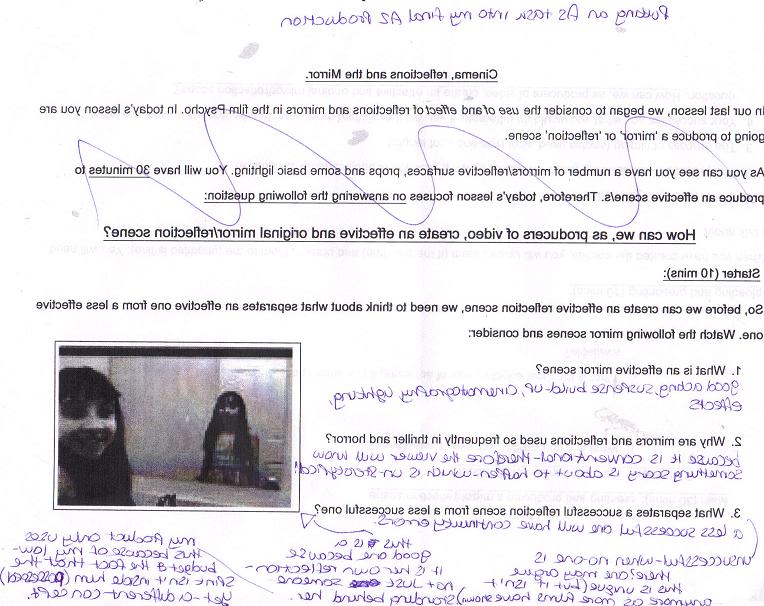
Typical Convention- Use of the mirror
This is a you-tube clip showing a montage of how many films use the scary, behind-the-mirror technique. It's a convention that is so over-used that films are making parody scenes of it. I am considering using this technique- to follow conventions so that you know something is going to happen, but also to make a twist on the technique.
Why do people enjoy being scared? Joe Bob Briggs, noted "drive in movie" critic, says that "We like to frighten ourselves so that everything else in our lives seems less frightening" Roger Ebert states that good horror movies "can exorcise our demons" ("The Texas Chainsaw Massacre"). Horror movies affect the watcher in tangible physical ways, as well. Fear stimulates the 'fight or flight' response, which kicks off with a rush of endorphins that make the body more alert, tighten the muscles, and slow down nonessential functions like digestion.
It is possible that the screen acts as a mirror to the audience, who is, after all, deceived as it believes the narrative it sees on the screen to be true when in fact it is merely another well constructed deception. The camera is able to go everywhere, see everything, and ultimately has no limits. The audience's feeling of power is enhanced further by the fact that they are sitting in a darkened, relatively unexposed, 'safe-feeling' auditorium, passively watching the lives of others.
So, what effect does it have to use mirrors within the film itself? Well, some would argue that through the use of mirror in film, the spectator itself is exposed and thrown into the action, no longer just a passive viewer of the action, but an active part of the action, rudely revealed or harshly thrown into the light and action. The safety and comfort of the auditorium is shattered as they become aware of their own vulnerability. Therefore, the cinematic screen becomes the 'mirror of childhood' described in Lacan's mirror stage. This awareness consequently produces an anxiety in the subject who is unsure whose point of view is being depicted, the on-screen characters or their own. This is made worse as the audience relates this experience to its childhood, where they may well have felt even more exposed and vulnerable. This could be the cause of making mirrors scary in film, and why it has been used so often.
Scariest film scenes:
Thursday, 8 December 2011
Focus Group
A focus group is a form of qualitative research in which a group of people are asked about their perceptions, opinions, beliefs and attitudes towards a product. My focus group will include roughly 3-4 people, ranging from 18-45, some fitting into my target audience, and one that isn't- to determine their attitudes towards my trailer and whether they would pay to watch it or not. I will be examining their responses and asking them their thoughts about my storyline, techniques used in my trailer, poster and webpage. I have recorded an question and answer session in my focus group, where the focus group will ask me whatever they need/want to know.
Synopsis
'Son Of Perdition' is a thrilling horror, jam-packed with drama and theatrical psychology. We follow an 18-year-old male, Matthew Jones, as his life is intruded by a mysterious spirit when in the forbidden forest. It begins to possess him and his haunting obsession is revealed shockingly towards the end. With the help of an old, creepy medium, will his life ever be the same? And Is this spirit even real or the act of imagination?
Representation of women
"The surveyor of woman in herself is male: the surveyed female. Thus she turns herself into an object - and most particularly an object of vision: a sight" - John Berger in 'Ways of Seeing'. I think what he is saying that men objectify women when they look at them, and women watch themselves being looked at. The pleasure of looking is called Scopophilia. In my media product, I have unknowingly decided to use moderately attractive women through a fault of lack of choice. However, this may attract more males as a audience. I may also relate my trailer product with the Oedipus complex because it involves a brief connection between mother and son. Laura Mulvey (1975) states that psychoanalyst Sigmund Freud associates Scopophilia with "taking other people as objects, subjecting them to a controlling and curious gaze... at the extreme, it can become fixated into a perversion, producing obsessive voyeurs and Peeping Tom's whose only sexual satisfaction can come from watching, in an active controlling sense, an objectified other".
She argues that the environment of the cinema a "hermetically sealed world which unwinds magically" with its lack of light and inability to interact with other spectators produces the ideal environment for voyeurism where spectators can look in on a "private world". She also argues that the gaze of the male spectator is united with that of the male protagonist. They become one man, looking at women. As I am using a male protagonist, this may happen but hopefully the main content of horror will distract and take-away from this.
'Rear Window' by Alfred Hitchcock has influenced my product of representations. Although I have a male protagonist, he is also the victim which deliberately goes against the traditional representations. Similarly to this film, I previously decided I could of added an extra female to the trailer to represent how the camera will not embody the males 'gaze'. If I add in the main characters partner, there will not only be intertextual romance but similar to Rear Window, the man will be more occupied/disturbed by his observations than that of the girlfriend. I would use this if I was making an extension trailer or the whole film.
How the character changes

In films like these (another example is Phonebooth) the main male character is introduced as selfish and arrogant. Freytag's pyramid diagrammed every story's plot. However, In my opinion, I think one can similarly do this for a character and how what they've been through has changed them from start to finish. Perhaps the character deserves the incident they are placed in, and this is the purpose of the stories; to change morals. For example, the protagonist's mother told him not to go in the woods, yet he lied and he did enter the woods. Thus, he perhaps caused the 'problem' himself, like walking into a fire or the boy who cried wolf.
 Freytag's pyramid consists of:
2. Inciting Incident: something happens to begin the action. A single event usually signals the beginning of the main conflict. The inciting incident is often referred to as the complication.
3. Rising Action: the story builds and gets more exciting.
4. Climax: the moment of greatest tension in a story. This is often the most exciting event and the rising action builds up to this, and that of which the falling action follows.
5. Falling Action: events happen as a result of the climax and we know that the story will soon end.
6. Resolution: the character solves the main problem/conflict or someone solves it for him or her.
7. Denouement: the ending. At this point, any remaining secrets, questions or mysteries which remain after the resolution are solved by the characters or explained by the author. Sometimes the author leaves us to think about the theme or future possibilities for the characters which could result in another film.
The highlighted points are ones I will use in my trailer. As it is only a teaser trailer, these points will be brief and I will not reveal the ending or how to solve the problem.
Source: http://web.cn.edu/kwheeler/freytag.html
Subscribe to:
Posts (Atom)